

Seoul holds back on private car curbs
Seoul holds back on private car curbs
Posted April. 11, 2026 08:45,
Updated April. 11, 2026 08:45
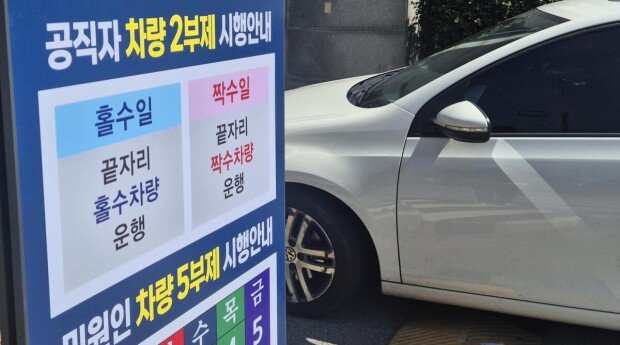
The South Korean government is taking a cautious approach to extending vehicle rationing to the private sector, even as it tightens restrictions on public vehicles in response to energy supply risks tied to Middle East tensions. Officials say the expected benefits are limited, while enforcement would be costly, requiring extensive monitoring and penalties.
At 12 a.m. on April 2, the government raised its oil resource security alert to “warning” and began enforcing an odd-even driving system for public-sector vehicles on April 8. Public parking lots operated by local governments have also adopted a five-day rotation system based on license plate numbers. For now, however, authorities are not considering mandatory restrictions on privately owned vehicles.
An official at the Ministry of Climate, Energy and Environment said any expansion to private vehicles would require a careful assessment of energy conditions, as well as the potential impact on daily life and the broader economy. “Nothing has been decided,” the official said.
The government’s caution reflects doubts about whether the policy would yield meaningful results given the inconvenience it would impose. The ministry estimates the public-sector odd-even system could reduce oil consumption by 17,000 to 87,000 barrels per month, while the parking rotation could save an additional 5,000 to 27,000 barrels. With South Korea consuming about 2.8 million barrels of oil a day, even a month of such measures would cut less than 4 percent of daily demand.
There are few precedents for mandatory vehicle rationing that includes private cars. During the first oil shock in the 1970s, authorities banned the use of luxury passenger vehicles, though living standards were markedly different at the time. The most comprehensive case came during the 1991 Gulf War, when a nationwide 10-day rotation system was enforced for about two months, covering both public and private vehicles. During the 1997 Asian financial crisis, a similar measure was considered but never implemented. Temporary odd-even systems were introduced in select areas during major international events such as the 1988 Seoul Olympics and the 2002 Korea-Japan World Cup, but those efforts were aimed at easing traffic congestion rather than conserving energy.
Although the conflict in the Middle East has entered a ceasefire phase, a lasting resolution remains uncertain. Renewed tensions could once again disrupt crude oil supplies, leaving room for a further escalation in the oil security alert system. The system has four tiers, interest, caution, warning and severe, based on supply conditions and their impact on the economy and daily life.
The government raised the alert to “warning” on April 2. Oh Il-young, director general for climate and energy policy, said that at the current level, the private sector is being encouraged to adopt the five-day system voluntarily. “If the alert is raised further, mandatory measures could be considered, but nothing has been finalized,” he said.
세종=정순구 soon9@donga.com

![[사설]“尹 계엄 하려 北 도발 유도”… 무지한 건지, 무모한 건지](https://dimg.donga.com/c/138/175/90/1/wps/NEWS/IMAGE/2026/06/12/134104085.1.jpg)


 About Dong-A Ilbo