

Chip surge lifts South Korea exports to record
Chip surge lifts South Korea exports to record
Posted April. 02, 2026 09:24,
Updated April. 02, 2026 09:24
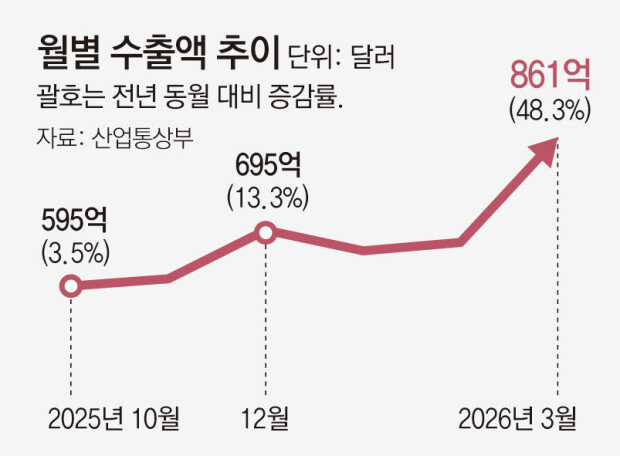
South Korea’s exports reached a record high in March, topping $80 billion for the first time as strong semiconductor demand fueled growth despite rising risks tied to the Middle East conflict.
Exports totaled $86.13 billion, up 48.3 percent from a year earlier, according to data released April 1 by the Ministry of Trade, Industry and Energy. The figure surpassed the previous record of $69.5 billion set in December and marked a tenth consecutive monthly high since exports turned upward last June.
Semiconductors led the increase. Chip exports surged 151.4 percent year-on-year to $32.83 billion, breaking the previous record of $25.1 billion set in February. It was the first time monthly semiconductor exports exceeded $30 billion.
Kang Gam-chan, director general for trade and investment at the ministry, said firm DRAM prices and a rise in working days toward the end of the quarter boosted both production and shipments. He added that, despite ongoing uncertainties, chip exports are expected to remain on a positive track through at least the first half of the year.
Automobile exports rose 2.2 percent to $6.37 billion, supported by continued growth in eco-friendly vehicles. Electric vehicle exports increased 32 percent, while hybrid models rose 38 percent, helping offset logistical disruptions linked to the Middle East conflict.
Despite the strong headline figures, concerns are growing over the economy’s heavy reliance on semiconductors. Chips accounted for a record 38.1 percent of total exports in March, up from about 20 percent in previous years and 24 percent last year.
The impact of the Middle East conflict is also spreading across industries, particularly in refining and petrochemicals, which face export controls and price caps. While petroleum product exports rose 54.9 percent in value terms on higher global prices, shipments of gasoline, diesel and kerosene declined by 5 percent, 11 percent and 12 percent, respectively, after export restrictions took effect on March 13. Petrochemical exports also weakened, with shipment volumes falling 17 percent in the fourth week of March as the effects of the conflict intensified.
Industry Minister Kim Jung-kwan said the government will activate a coordinated response to manage rising uncertainty and move swiftly to stabilize export conditions as the conflict continues.
세종=정순구 기자 soon9@donga.com

![[속보]트럼프 “호르무즈 못가면 미국산 석유 사라…앞으로 2∼3주 이란 극도로 강하게 타격”](https://dimg.donga.com/c/138/175/90/1/wps/NEWS/IMAGE/2026/04/02/133660023.1.jpg)




 About Dong-A Ilbo