

BOS Semiconductors Eyes Expansion into ‘Intelligent Space’ AI Market Beyond ADAS
BOS Semiconductors Eyes Expansion into ‘Intelligent Space’ AI Market Beyond ADAS
Posted November. 27, 2025 09:27,
Updated November. 27, 2025 09:29
- BOS Semiconductors is rapidly expanding beyond automotive ADAS into broader AI markets with products like the Eagle-N AI accelerator and has formed strategic partnerships, including with Tenstorrent, while achieving key certifications. \
- The company emphasizes the importance of a unified software ecosystem, led by CSO Won-joo Park, to maximize hardware performance and is actively collaborating with global OEMs and research institutes to optimize their technology for intelligent spaces such as infotainment, robotics, and drones.
- BOS Semiconductors is also investing in ecosystem partnerships and global marketing, participating in programs like the SBA’s Super Gap Open Innovation Promotional Support Program to accelerate its global expansion and commercialization efforts.
“The role of software is to ensure that hardware delivers 100% of the performance required by the customer. To achieve this, we need a unified software ecosystem unique to BOS Semiconductors that weaves the industry together. Based on the twin pillars of creative innovation and engineering excellence, we are building a strategy to connect everyone at the center of this ecosystem.”
We met Won-joo Park, Chief Software Officer (CSO) of BOS Semiconductors, at the company’s headquarters to discuss the future of mobility silicon.
BOS Semiconductors, founded in May 2022 by CEO Jae-hong Park, is a fabless company specializing in automotive system semiconductors. Its product lineup includes the ‘Eagle-N,’ a chiplet-based AI accelerator applicable not only to vehicles—such as Advanced Driver Assistance Systems (ADAS) and In-Vehicle Infotainment (IVI)—but also to diverse ‘Physical AI’ fields like robots and drones. The company also offers the ‘Eagle-A,’ an all-in-one AI System-on-Chip (SoC).
Despite being established only three years ago, BOS Semiconductors has secured a strategic partnership with the global AI chip unicorn Tenstorrent. It has also achieved ISO 26262 certification—the international standard for functional safety in automotive electric/electronic systems—essential for any player dealing with global automakers.
However, the semiconductor industry requires more than just hardware; a robust software ecosystem is equally critical. No matter how well-designed the hardware is, its performance cannot be fully realized without a proper software framework to operate it. Recognizing this, leading AI chipmakers are increasingly prioritizing software, ensuring it operates in lockstep with their hardware.
CSO, Park : The Man Behind the Software
At BOS Semiconductors, CSO Won-joo Park oversees software development and ecosystem creation. Park is a veteran of the global software industry. He spent over a decade at Microsoft, serving as a development lead for Windows and Internet Explorer. Later, he moved to Samsung Electronics, where he held key leadership roles at the Digital Media & Communications (DMC) R&D Center, the Software Center, and served as the Head of the Software R&D Center for the Device Solutions (DS) Division.
In 2017, Park moved to academia as a professor of industry-university cooperation at Sungkyunkwan University and was preparing for retirement. However, CEO Jae-hong Park reached out to him.
“I worked with CEO Park when he was in the LSI (Large Scale Integration) business unit at Samsung Electronics,” Park recalled. “I was preparing for a break after my time as a professor, but he asked me to take charge of the software division, so I joined BOS Semiconductors in February this year.” He added that the desire to “build a better foundation for the juniors who will lead Korea’s future” outweighed the desire for rest.
Park’s appointment as CSO was publicly announced in May, and six months have passed since then. When asked about the company’s achievements this year, Park highlighted the market reception of their flagship product.
“The market reaction to our main semiconductor, the Eagle-N, has been enthusiastic. The hardware production was completed in February, and since May, we have been applying and demonstrating AI models requested by major clients,” Park stated. “While general AI accelerators must be developed by predicting market demand years in advance, automotive semiconductors have clear destinations. We can design exactly for the purpose the client requires.”
Park continued, “Until now, we focused on ADAS and autonomous driving, and last May, we successfully demonstrated an End-to-End autonomous driving AI model (SSR). Recently, requests for future-oriented models have been coming in from clients. Since the chip itself is a Neural Processing Unit (NPU), we confirmed that it can run Large Language Models (LLMs) with 10 billion parameters, such as Llama 8B and Qwen 8B.”
He added that the company is currently collaborating with global OEMs and automotive research institutes, noting, “Long-term, we intend to respond to the entire intelligent space, including infotainment.”
“Superior Performance-Per-Watt Confirmed, With Room to Grow”
The Eagle-N is scheduled for mass production in the second half of next year, and the team is currently focused on memory optimization to maximize performance.
“The Tenstorrent Tensix NPU itself is designed to be advantageous for data flow. Even with 250 TOPS (Trillions of Operations Per Second), we can achieve superior cost-performance (TOPS per dollar) and performance-per-watt (TOPS per watt) compared to competitors,” Park explained. “The NPU core contains five RISC-V cores. Two of them are dedicated to data processing, rapidly and continuously moving models and data weights to DRAM and SRAM at the application process level. Using cores to eliminate bottlenecks and optimize flow is the competitive edge of Eagle-N.”
Park also mentioned that performance could be further enhanced through hierarchical memory structures and data movement minimization.
“In the future, the data movement path between memory and calculation cores will be significantly more efficient, allowing us to stably boost overall system performance,” he said. “We have a specialized team dedicated to model optimization and improving memory access efficiency. Various technologies to maximize real-world performance are continuously being developed and refined.”
He emphasized the synergy between teams: “The organizational structure is built for strong collaboration, as the software team must understand the logic and intent designed by the hardware team during the configuration stage.”
Regarding power efficiency, Park noted, “Even at this stage, we are seeing high computational efficiency relative to power. We are confirming performance exceeding expectations even under conditions where the product’s operating speed or memory environment is not yet fully implemented. I am confident about commercialization next year, and the final product’s performance will likely improve further. We plan to surprise everyone.”
A Battle-Hardened Team with Rich SoC Experience
The background behind BOS Semiconductors’ rapid growth within three years of its founding lies in the collective competence of its employees.
“Making a semiconductor is the pinnacle of engineering,” Park began. “You design a chip for a purpose, design it at the Register Transfer Level (RTL), create an FPGA and firmware to verify it. Then you make it into a wafer chip, integrate the OS, and verify it again. If there is even a small mistake in the entire process, the whole project faces problems.”
“People with experience commercializing System-on-Chips (SoCs) are rare in the industry,” he continued. “However, the team leaders and executives at BOS Semiconductors are engineers who have launched chips at least three times alongside CEO Jae-hong Park, weathering all sorts of challenges together. This is the background that allows us to have the capacity to handle design services even though the company is only in its fourth year and has just released its first product. The software team is also leading the business in strict alignment with this.”
A flexible corporate culture designed to keep pace with the fast-changing AI industry is another hallmark of BOS Semiconductors.
“The competitiveness of software ultimately comes from people. To produce creative results, you must have a flexible mindset; otherwise, the company’s competitiveness suffers. An authoritative culture is the thing to guard against most,” Park said. “We have a culture where we sit together during meetings and debate opinions regardless of rank. To prevent ‘reporting for the sake of reporting,’ we review the design documents themselves during technical discussions.”
Ecosystem Collaboration and Global Expansion with SBA
BOS Semiconductors is on an upward trajectory with the goal of product launch next year. On the software side, the company is investing heavily in securing an ecosystem through partnerships and is striving to enter overseas markets.
“We are collaborating with several domestic AI software companies. We start by co-developing AI models requested by clients and work together to build models that are difficult to handle internally alone. We are also securing partners in the autonomous driving sector. Our goal is to be the center of—and collaborate with—everything related to computing within the vehicle,” Park explained.
Park also introduced Jason Chae, CSMO (Chief Sales & Marketing Officer), emphasizing that completing a single semiconductor requires expertise in hardware, software, sales, and marketing, all working organically.
To further promote the brand globally, BOS Semiconductors is participating in the "Super Gap Open Innovation Promotional Support Program" run by the Seoul Business Agency (SBA). This program supports effective PR and marketing capabilities for selected deep-tech companies.
“Early this year, we attended CES 2025 and Auto Shanghai 2025. On the technical front, we are making efforts to publicize BOS Semiconductors by attending the IMEC Automotive Chiplet Forum and co-developing the Open Chiplet Atlas (OCA) with Tenstorrent. We are delighted to have the opportunity to showcase the potential and technical prowess of our employees more widely with the help of the SBA,” Park said.
In closing, Park shared his outlook: “As the AI market shifts, the front lines of the autonomous driving market have widened. The expansion possibilities are so vast that companies are currently in a reconnaissance phase. For BOS Semiconductors, this means we can broaden our business areas and establish a base for new revenue. The next two to three years will likely be the decisive moment. We intend to show various opportunities as reality, not just possibility, and we are committed to succeeding no matter what. Starting in the second half of next year, we will achieve commercialization across our products, including Eagle-N, and step-by-step approach larger markets.”
By Si-hyeon Nam (sh@itdonga.com)
- The company emphasizes the importance of a unified software ecosystem, led by CSO Won-joo Park, to maximize hardware performance and is actively collaborating with global OEMs and research institutes to optimize their technology for intelligent spaces such as infotainment, robotics, and drones.
- BOS Semiconductors is also investing in ecosystem partnerships and global marketing, participating in programs like the SBA’s Super Gap Open Innovation Promotional Support Program to accelerate its global expansion and commercialization efforts.
“The role of software is to ensure that hardware delivers 100% of the performance required by the customer. To achieve this, we need a unified software ecosystem unique to BOS Semiconductors that weaves the industry together. Based on the twin pillars of creative innovation and engineering excellence, we are building a strategy to connect everyone at the center of this ecosystem.”
We met Won-joo Park, Chief Software Officer (CSO) of BOS Semiconductors, at the company’s headquarters to discuss the future of mobility silicon.
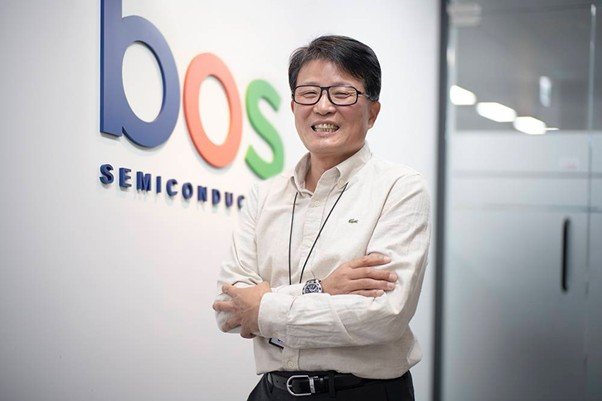
Won-joo Park, CSO of BOS Semiconductors / source=IT dongA
BOS Semiconductors, founded in May 2022 by CEO Jae-hong Park, is a fabless company specializing in automotive system semiconductors. Its product lineup includes the ‘Eagle-N,’ a chiplet-based AI accelerator applicable not only to vehicles—such as Advanced Driver Assistance Systems (ADAS) and In-Vehicle Infotainment (IVI)—but also to diverse ‘Physical AI’ fields like robots and drones. The company also offers the ‘Eagle-A,’ an all-in-one AI System-on-Chip (SoC).
Despite being established only three years ago, BOS Semiconductors has secured a strategic partnership with the global AI chip unicorn Tenstorrent. It has also achieved ISO 26262 certification—the international standard for functional safety in automotive electric/electronic systems—essential for any player dealing with global automakers.
However, the semiconductor industry requires more than just hardware; a robust software ecosystem is equally critical. No matter how well-designed the hardware is, its performance cannot be fully realized without a proper software framework to operate it. Recognizing this, leading AI chipmakers are increasingly prioritizing software, ensuring it operates in lockstep with their hardware.
CSO, Park : The Man Behind the Software
At BOS Semiconductors, CSO Won-joo Park oversees software development and ecosystem creation. Park is a veteran of the global software industry. He spent over a decade at Microsoft, serving as a development lead for Windows and Internet Explorer. Later, he moved to Samsung Electronics, where he held key leadership roles at the Digital Media & Communications (DMC) R&D Center, the Software Center, and served as the Head of the Software R&D Center for the Device Solutions (DS) Division.
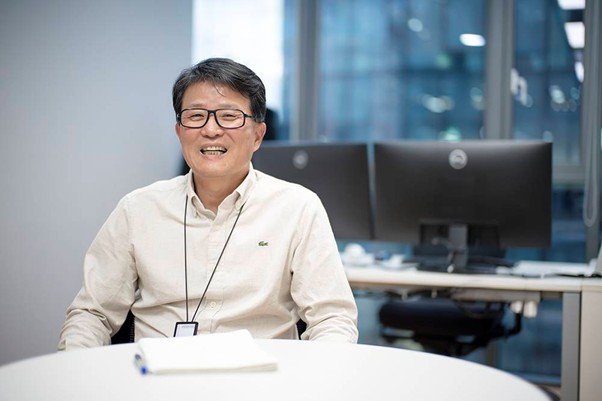
Park is considered a living history of the semiconductor software industry, with over 30 years of experience spanning Microsoft and Samsung / source=IT dongA
In 2017, Park moved to academia as a professor of industry-university cooperation at Sungkyunkwan University and was preparing for retirement. However, CEO Jae-hong Park reached out to him.
“I worked with CEO Park when he was in the LSI (Large Scale Integration) business unit at Samsung Electronics,” Park recalled. “I was preparing for a break after my time as a professor, but he asked me to take charge of the software division, so I joined BOS Semiconductors in February this year.” He added that the desire to “build a better foundation for the juniors who will lead Korea’s future” outweighed the desire for rest.
Park’s appointment as CSO was publicly announced in May, and six months have passed since then. When asked about the company’s achievements this year, Park highlighted the market reception of their flagship product.
“The market reaction to our main semiconductor, the Eagle-N, has been enthusiastic. The hardware production was completed in February, and since May, we have been applying and demonstrating AI models requested by major clients,” Park stated. “While general AI accelerators must be developed by predicting market demand years in advance, automotive semiconductors have clear destinations. We can design exactly for the purpose the client requires.”
Park continued, “Until now, we focused on ADAS and autonomous driving, and last May, we successfully demonstrated an End-to-End autonomous driving AI model (SSR). Recently, requests for future-oriented models have been coming in from clients. Since the chip itself is a Neural Processing Unit (NPU), we confirmed that it can run Large Language Models (LLMs) with 10 billion parameters, such as Llama 8B and Qwen 8B.”
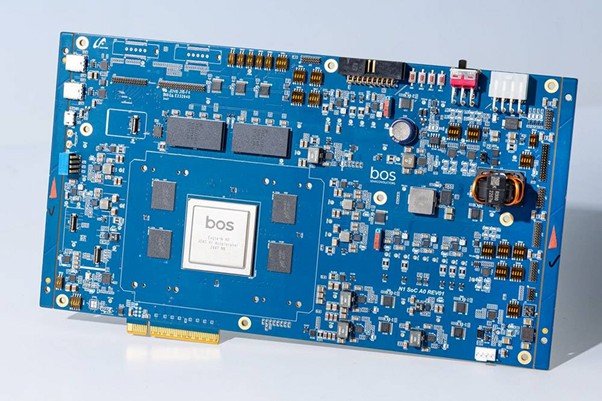
Eagle-N of BOS Semiconductors / source=Bos Semiconductors
He added that the company is currently collaborating with global OEMs and automotive research institutes, noting, “Long-term, we intend to respond to the entire intelligent space, including infotainment.”
“Superior Performance-Per-Watt Confirmed, With Room to Grow”
The Eagle-N is scheduled for mass production in the second half of next year, and the team is currently focused on memory optimization to maximize performance.
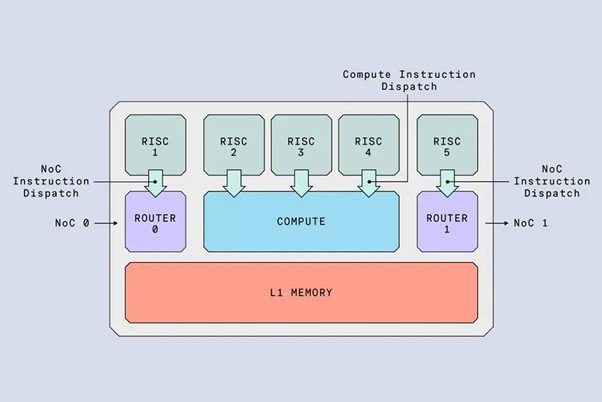
“The Tenstorrent Tensix NPU itself is designed to be advantageous for data flow. Even with 250 TOPS (Trillions of Operations Per Second), we can achieve superior cost-performance (TOPS per dollar) and performance-per-watt (TOPS per watt) compared to competitors,” Park explained. “The NPU core contains five RISC-V cores. Two of them are dedicated to data processing, rapidly and continuously moving models and data weights to DRAM and SRAM at the application process level. Using cores to eliminate bottlenecks and optimize flow is the competitive edge of Eagle-N.”
Park also mentioned that performance could be further enhanced through hierarchical memory structures and data movement minimization.
The RISC-V cores within the Tenstorrent Tensix NPU integrated into the Eagle-N. Two of these cores are dedicated to control and instruction dispatch / source=Tenstorrent
“In the future, the data movement path between memory and calculation cores will be significantly more efficient, allowing us to stably boost overall system performance,” he said. “We have a specialized team dedicated to model optimization and improving memory access efficiency. Various technologies to maximize real-world performance are continuously being developed and refined.”
He emphasized the synergy between teams: “The organizational structure is built for strong collaboration, as the software team must understand the logic and intent designed by the hardware team during the configuration stage.”
Regarding power efficiency, Park noted, “Even at this stage, we are seeing high computational efficiency relative to power. We are confirming performance exceeding expectations even under conditions where the product’s operating speed or memory environment is not yet fully implemented. I am confident about commercialization next year, and the final product’s performance will likely improve further. We plan to surprise everyone.”
A Battle-Hardened Team with Rich SoC Experience
The background behind BOS Semiconductors’ rapid growth within three years of its founding lies in the collective competence of its employees.
“Making a semiconductor is the pinnacle of engineering,” Park began. “You design a chip for a purpose, design it at the Register Transfer Level (RTL), create an FPGA and firmware to verify it. Then you make it into a wafer chip, integrate the OS, and verify it again. If there is even a small mistake in the entire process, the whole project faces problems.”
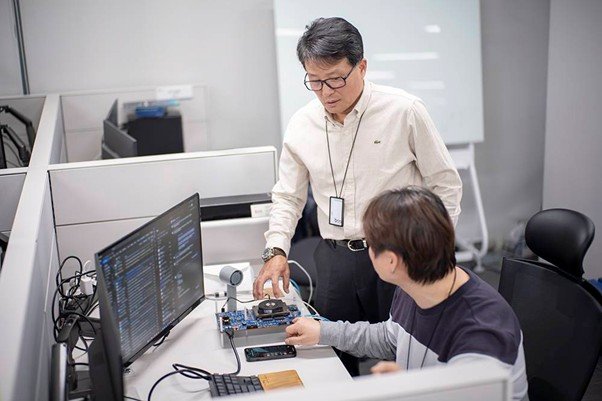
Park is discussing the product with developer / source=IT dongA
“People with experience commercializing System-on-Chips (SoCs) are rare in the industry,” he continued. “However, the team leaders and executives at BOS Semiconductors are engineers who have launched chips at least three times alongside CEO Jae-hong Park, weathering all sorts of challenges together. This is the background that allows us to have the capacity to handle design services even though the company is only in its fourth year and has just released its first product. The software team is also leading the business in strict alignment with this.”
A flexible corporate culture designed to keep pace with the fast-changing AI industry is another hallmark of BOS Semiconductors.
“The competitiveness of software ultimately comes from people. To produce creative results, you must have a flexible mindset; otherwise, the company’s competitiveness suffers. An authoritative culture is the thing to guard against most,” Park said. “We have a culture where we sit together during meetings and debate opinions regardless of rank. To prevent ‘reporting for the sake of reporting,’ we review the design documents themselves during technical discussions.”
Ecosystem Collaboration and Global Expansion with SBA
BOS Semiconductors is on an upward trajectory with the goal of product launch next year. On the software side, the company is investing heavily in securing an ecosystem through partnerships and is striving to enter overseas markets.
“We are collaborating with several domestic AI software companies. We start by co-developing AI models requested by clients and work together to build models that are difficult to handle internally alone. We are also securing partners in the autonomous driving sector. Our goal is to be the center of—and collaborate with—everything related to computing within the vehicle,” Park explained.
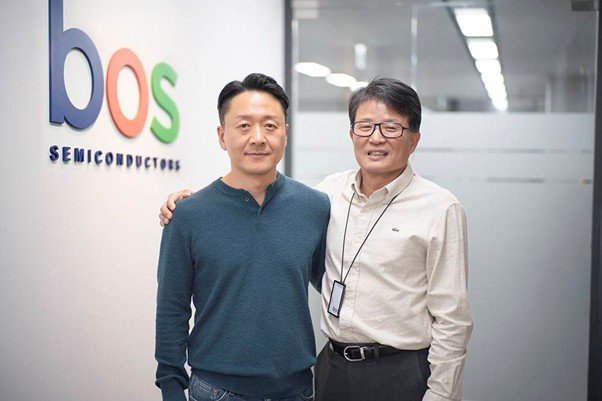
Park also introduced Jason Chae, CSMO (Chief Sales & Marketing Officer), emphasizing that completing a single semiconductor requires expertise in hardware, software, sales, and marketing, all working organically.
To further promote the brand globally, BOS Semiconductors is participating in the "Super Gap Open Innovation Promotional Support Program" run by the Seoul Business Agency (SBA). This program supports effective PR and marketing capabilities for selected deep-tech companies.
“Early this year, we attended CES 2025 and Auto Shanghai 2025. On the technical front, we are making efforts to publicize BOS Semiconductors by attending the IMEC Automotive Chiplet Forum and co-developing the Open Chiplet Atlas (OCA) with Tenstorrent. We are delighted to have the opportunity to showcase the potential and technical prowess of our employees more widely with the help of the SBA,” Park said.
In closing, Park shared his outlook: “As the AI market shifts, the front lines of the autonomous driving market have widened. The expansion possibilities are so vast that companies are currently in a reconnaissance phase. For BOS Semiconductors, this means we can broaden our business areas and establish a base for new revenue. The next two to three years will likely be the decisive moment. We intend to show various opportunities as reality, not just possibility, and we are committed to succeeding no matter what. Starting in the second half of next year, we will achieve commercialization across our products, including Eagle-N, and step-by-step approach larger markets.”
By Si-hyeon Nam (sh@itdonga.com)







 About Dong-A Ilbo