

Constitutional Court mentions responsibility of both Yoon and National Assembly
Constitutional Court mentions responsibility of both Yoon and National Assembly
Posted April. 05, 2025 07:13,
Updated April. 05, 2025 07:13
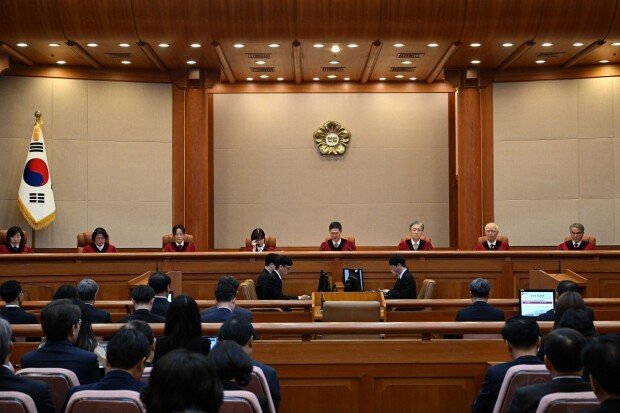
The South Korean Constitutional Court, in its ruling on Friday, mentioned the responsibility of both former President Yoon Suk Yeol and the National Assembly regarding their conflict. Toward former President Yoon, it pointed out that he should have respected the National Assembly, the representative of the people, as a partner in governance as defined by the Constitution. Toward the National Assembly, it stated that it should have made efforts to reach conclusions through dialogue and compromise, based on tolerance and restraint, in its relationship with the government."
In its written decision, the Court cited Article 1, Clause 1 of the Constitution ("The Republic of Korea shall be a democratic republic.") and emphasized the necessity of tolerance and cooperation, stating, "Democracy is fundamentally a process of autonomous and cooperative public decision-making based on respect and fraternity among fellow citizens." It further criticized the National Assembly, stating it "must respect minority opinions in the interest of the entire public rather than partisan interests." This seems to point out the repeated impeachments under the Yoon Suk Yeol administration in a National Assembly dominated by the Democratic Party of Korea, and the lack of cooperation with relatively smaller parties such as the People Power Party amid conflicts with the executive branch.
The Court explained the background behind former President Yoon's declaration of the December 3 emergency martial law, stating, "As the head of the executive and the head of state, he likely felt a heavy sense of responsibility that national administration was being paralyzed and national interests significantly harmed due to the tyranny of the opposition party." The phrase "tyranny of the opposition party" appears to refer to the Democratic Party of Korea-led operation of the National Assembly. "The confrontation between the government and the National Assembly cannot be considered solely the fault of one side. It is a political issue that must be coordinated and resolved in accordance with the principles of democracy," the Court added, attributing responsibility to both former President Yoon and the National Assembly.
"If the administration judged that important policies could not be realized due to opposition from the National Assembly, it could have sought to persuade through constitutional amendments, referendums, or submission of legislative bills via the government, to improve the power structure or system," the Court continued. This was a criticism that he should have responded through normal constitutional and legal procedures, not by exercising emergency powers such as martial law. "Even if President Yoon believed the current political situation was seriously harming national interests, he should have responded in accordance with democratic procedures and methods prescribed by the Constitution and the law," it added.
이승우 기자 suwoong2@donga.com


![[오늘의 운세/7월 2일]](https://dimg.donga.com/c/138/175/90/1/wps/NEWS/IMAGE/2026/07/02/134221102.1.jpg)


 About Dong-A Ilbo