

Half of Koreans say marriage is not a must
Half of Koreans say marriage is not a must
Posted November. 16, 2016 07:11,
Updated November. 16, 2016 07:17
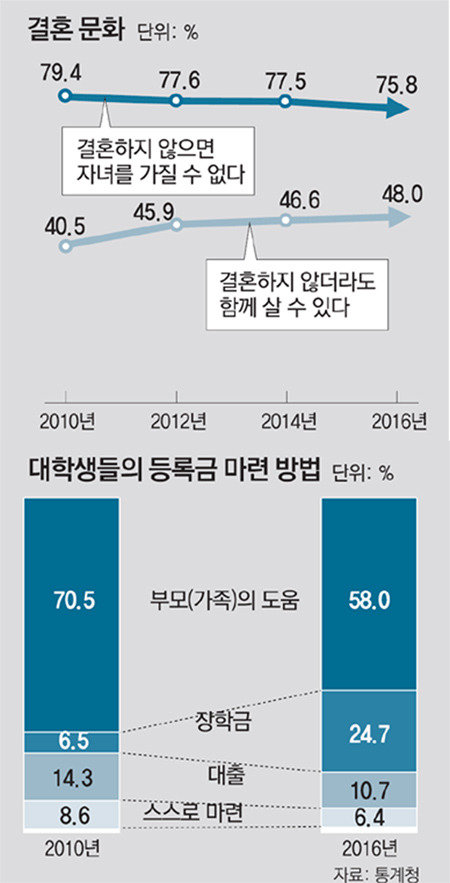
According to the Statistics Korea’s “Society survey 2016” published on Tuesday, 48 percent of Korean population above 13 years old responded that they have a favorable view on couples living together without getting married to each other. This is a 7.5 percentage-point growth from 40.5 percent in 2010. In the meantime, the ratio of respondents saying “marriage is a must” declined drastically from 64.7 percent to 51.9 percent. On the other hand, 75.8 percent of respondents replied that they have opposing ideas about unmarried couple having a child, hinting a highly conservative view in Korea.
For health, 54.7 percent of respondents, about five out of 10 Koreans, said that they are dealing with stress in everyday life. The No. 1 factor was stress from work life with 73.3 percent. Some 65.4 percent of Koreans above 19-year-old said they had more than a cup of alcohol over the last one year, up 0.8 percentage points compared to that of two years ago. The biggest obstacle in reducing or stopping drinking was social life with 53.1 percent, followed by stress with 41.1 percent. Smoking population decreased from 22.7% to 20.8%, a 1.9 percentage-point drop, over the same period.
Only 12 percent of respondents said that they feel Korea became safer than five years ago. Major incidents, including a series of merciless and cruel crimes, sinking of Sewol ferry and MERS scandal, have contributed to the trend. In particular, the ratio of respondents saying Korea will become safer five years later declined by 4.8 percent from two years ago. The biggest factor for anxiety was crime with 29.7 percent, followed by national security (19.3 percent) and financial risk (15.5 percent).
On the environmental front, 79.4 percent of respondents blamed yellow dust and fine dust, 1.5 percentage-point growth from 77.9 percent in 2014.
Young-Il Son scud2007@donga.com



![[단독]통일교 ‘한학자 보고문건’에 ‘전재수’ 최소 7번 등장](https://dimg.donga.com/c/138/175/90/1/wps/NEWS/IMAGE/2025/12/22/133015670.1.jpg)
![먼지인 줄 알았더니…서랍 구석 ‘해충 배설물’ 습격 [알쓸톡]](https://dimg.donga.com/c/138/175/90/1/wps/NEWS/IMAGE/2025/12/19/133001422.3.png)


 About Dong-A Ilbo