

Bowls buried with King Jeongjo unveiled for the first time.
Bowls buried with King Jeongjo unveiled for the first time.
Posted June. 22, 2016 07:14,
Updated June. 22, 2016 07:42
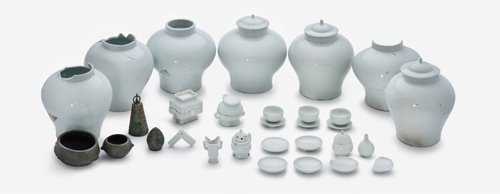
The National Palace Museum of Korea held a special exhibition titled “The royal tombs of the Joseon Dynasty contain the souls of the royal family.” The royal tombs for kings and queens were selected and the funerals were held according to the national courtesy protocol. The Royal Tombs of the Joseon Dynasty were listed on the UNESCO World Cultural Heritage in 2009.
The special exhibition revealed bowls buried with King Jeongjo (who served as a king from 1776 to 1800), which were buried in the tomb with him after his death. They are porcelains, wooden lacquerware, and bronze containers. The National Research Institute of Cultural Heritage discovered containers in a place between the royal tomb of Yungneung and the royal tomb of Geolleung in 2011. King Jeongjo’s royal tomb was relocated to Geolleung, the royal tomb for Queen Hyoeui, in 1821.
A royal coffin is a container for the dead body of a king for a national funeral. It was made whenever the king came to the throne and varnished with lacquer every year. The coffins in the exhibition were spare ones and was previously been reserved in a pavilion of Changdeok Palace. They were later moved to the National Palace Museum of Korea in 2005.
The exhibition consists of four parts. Part 1's title is "Set up the Royal Tombs of the Joseon Dynasty," which will exhibit the Royal Protocols including information on national funerals and a map describing the conditions of the site for royal tombs, and relics related to a government agency established for the creation of the royal tomb. Part 2, titled “Designate the Royal Tombs of the Joseon Dynasty,” introduces the components and the system of royal tombs. Part 3, whose title is "Take care," will exhibit utensils used for the memorial services. Part 4, titled “Take care of the royal tombs," shows recorded documents on each royal tomb. The exhibition ends on Aug. 28.
김상운 기자sukim@donga.com






 About Dong-A Ilbo