

Four-legged robot runs marathon on one charge
Four-legged robot runs marathon on one charge
Posted September. 24, 2026 08:22,
Updated September. 24, 2026 08:22
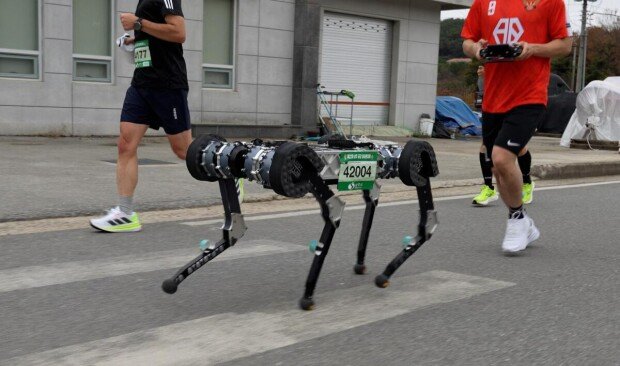
On Nov. 17, 2024, a four-legged robot called Raibo2 joined human runners at the starting line of the 22nd Sangju Dried Persimmon Marathon in Sangju, North Gyeongsang province. It climbed and descended the course before crossing the finish line in 4 hours, 19 minutes and 52 seconds. The robot covered all 42.195 kilometers without changing or recharging its battery, marking the first time a quadruped robot had completed a full marathon anywhere in the world.
Nearly two years later, researchers have figured out what made that finish possible. A team led by Hwangbo Jaemin, a professor of mechanical engineering at KAIST, analyzed more than four hours of real-world running data from the race and published its findings in the journal Nature, KAIST said Sept. 24.
The researchers mapped where Raibo2 lost energy while running and used the results to shape its design. Some of the electricity driving its leg-joint motors was lost as heat. Friction between moving joints and gears also drained energy, as did the impact and slippage of its feet against the ground. To curb those losses, the team fine-tuned the weight of the legs, the motors and the robot’s gait. The aim was simple: make sure it had enough energy to go the distance.
The team then worked out the speed that would give Raibo2 the greatest range for the least energy. At a slower pace, its onboard computers and sensors would have to run longer, pushing up overall power use. At a faster pace, its legs and landings would demand more energy. The sweet spot was about 3 meters per second, where Raibo2 could travel the farthest.
More battery capacity did not necessarily mean greater range. A larger battery can hold more electricity, but its extra weight also makes the robot use more energy to move its legs. Raibo2 drew more power going uphill and, on descents, used its motors as generators to recover some of that energy and feed it back into the battery. It consumed about 1,280 watt-hours over the full marathon, and researchers estimated it could travel about 65 kilometers on a full battery.
For the same body weight and distance traveled, Raibo2 used 32% less energy than a human. The researchers plan to apply the design to robots that patrol mountainous and disaster-hit areas and industrial facilities. “Our goal is to turn a robot with world-class energy efficiency and locomotion performance into a reliable product that anyone can use safely in industrial settings,” Hwangbo said.
전혜진 기자 sunrise@donga.com

![[오늘의 운세/9월 27일]](https://dimg.donga.com/c/138/175/90/1/wps/NEWS/IMAGE/2026/09/23/134730689.1.jpg)
![[오늘의 운세/9월 26일]](https://dimg.donga.com/c/138/175/90/1/wps/NEWS/IMAGE/2026/09/23/134730684.1.jpg)
![[오늘의 운세/9월 24일]](https://dimg.donga.com/c/138/175/90/1/wps/NEWS/IMAGE/2026/09/24/134730726.1.jpg)




 About Dong-A Ilbo