

Early Detection
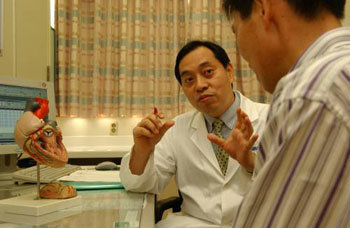
We met office worker Kim Sang-jin (alias, 50) last Thursday on his way home from the hospital where he received an operation to restore heart valves just a week ago.
Kim says the first time he felt something was wrong was in early March during a hiking trip to Mt. Gwanak. Usually he could hike for five or six hours easily, but on that day he felt out of breath from the start, and after an hour he had to call it quits.
A few days later Kim consulted his doctor for an X-ray. The doctor advised, Your heart is swollen, go see a university hospital, upon which Kim went to the Samsung Medical Center.
After an ultrasonic exam, he was diagnosed with valvular heart disease, and the hospital recommended surgery. The exact disease is called Mitral Valve Insufficiency, and it occurs when the valves of the heart do not open and close properly with the pumping of the heart.
Kim, who never experienced any symptoms except when climbing the stairs or mountain trails, asked, I dont feel inconvenienced, should I really undergo an operation?
Park Pyo-won, the chief of heart center head, showed Kim the ultrasound pictures.
You see the heart? From the center, you can tell that the left side is 1.5 times larger than the right. Your heart is swollen. He went on to explain the function of the heart and the valves.
The veins carry used blood into the left side of the heart and receives oxygen from the lungs, comes back into the left side and goes out to the entire body. Theres a valve in your heart that prevents the blood from running the other way. If the valve doesnt close correctly, a back-flow occurs and the heart becomes bloated.
Than why cant I feel anything in normal time? Kim asked.
Thats the problem. If you consider the severity of a back-flow on a scale of 1 to 10, you are about 8 or 9 already. Many patients normally dont feel uncomfortable in their everyday lives. They literally let their diseases grow, Park replied.
Kim wondered about the consequences of non-action.
Park said, About 1 to 2 percent of negligent patients die suddenly, or develop an irregular heartbeat and suffer strokes. Irregular pulses would then burst veins, which create blood clots, furthermore obstructing the blood flow.
You see this? Park showed Kim a key-shaped metal object. This is a synthetic valve. If the arrhythmia continues or the valve hardens, we have to put this in. If metal goes into the body, you have to take blood-thinning prescriptions for the rest of your life, he explained.
If the condition is detected early, all it requires is a restorative surgery that connects part of the valve to a cloth. Blood-thinning pills are only needed for the first 3 months after surgery.
Kim arranged the surgery for April 28, but because of his work schedule he postponed the date. He did not believe that three months would make a huge difference.
Kim underwent an examination before his hospitalization, and received a shock.
Park diagnosed him, saying, Arrhythmia has developed, and the severity of the back-flow has increased since the last time we checked three months ago, which has caused the right side of your heart to become swollen as well.
For Kim, fortunately, the arrhythmia was not continual and he only needed to cut away the sagging part of the valve.
artemes@donga.com




![장마당서 옷 팔던 北처녀, 인사동 개인전 열기까지[주성하의 북에서 온 이웃]](https://dimg.donga.com/c/138/175/90/1/wps/NEWS/IMAGE/2025/12/05/132901507.1.jpg)



 About Dong-A Ilbo